.png?width=600&height=150&name=D1CC%20Logo%20Version%202%20(1).png "Day 1 CPT logo")
Change of Status: H-1B to F-1
Process, Documents, Time, and Cost
Changing from H-1B to F-1 status remains a common strategy for professionals who want to pursue further education, maintain lawful status after a layoff, or explore alternative career pathways in the U.S. However, because USCIS processing times remain lengthy and immigration scrutiny has increased, proper planning is more important than ever. Learn more and let us guide you with helpful tips!
Challenges of H-1B Visa Holders
The H-1B visa remains one of the most popular pathways for international professionals seeking long-term career opportunities in the United States. For many international students, obtaining H-1B status represents a major milestone, providing the ability to work in specialty occupations and potentially pursue permanent residency through employer sponsorship.
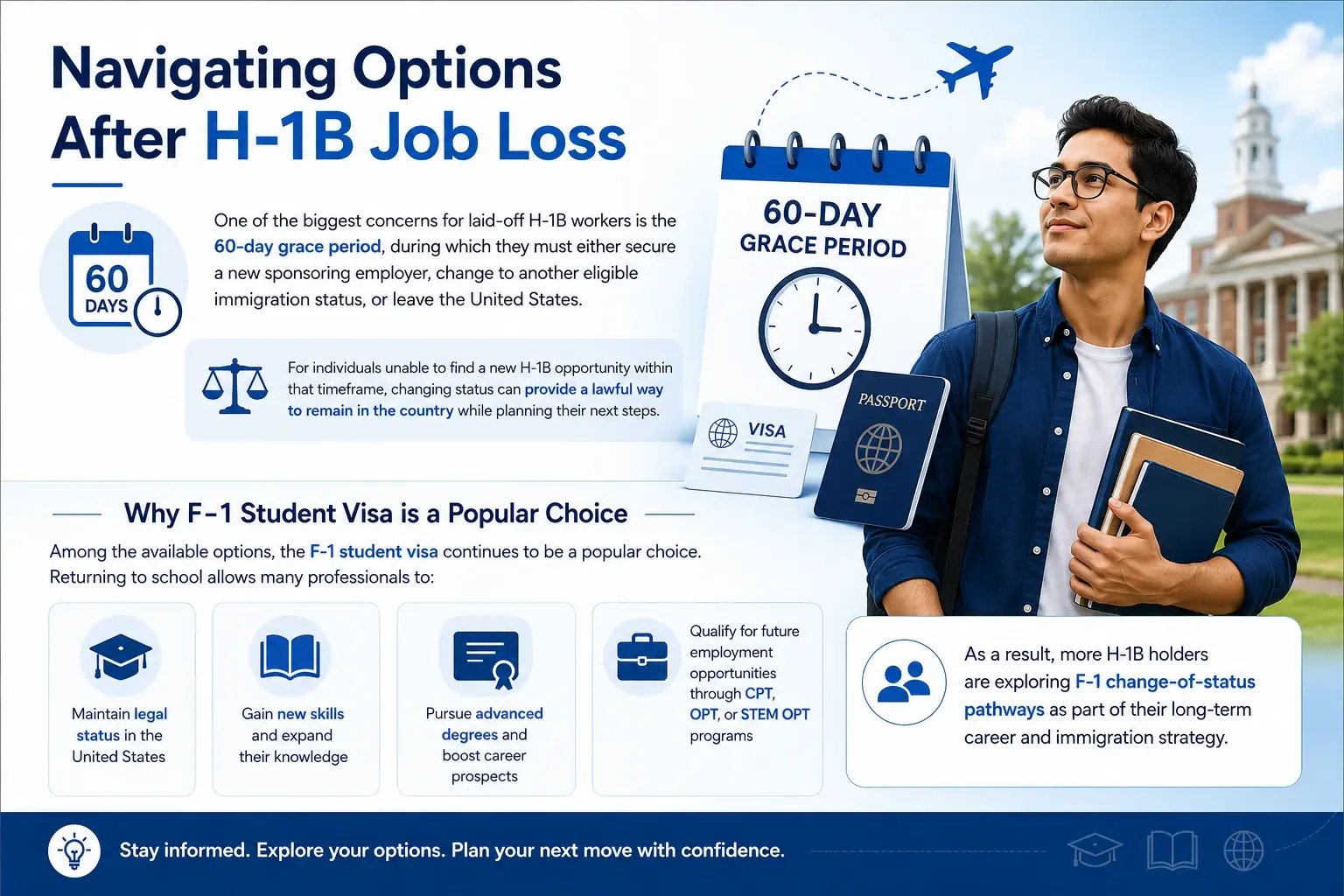
However, H-1B holders continue to face significant challenges. Ongoing workforce restructuring in the technology sector, economic uncertainty, and increased immigration scrutiny have left many professionals concerned about job stability and maintaining lawful status. Because H-1B status is tied to a sponsoring employer, job loss can quickly create immigration complications for both the visa holder and their dependent family members on H-4 status.
Apply Once. Unlock Benefits.
You Can't Get Anywhere Else!
Our direct partnerships with 20+ accredited universities mean we can negotiate exclusive scholarships, discounts, and support packages that are simply not available to students who apply on their own.
Scholarships applied directly to tuition — no repayment
Discounts are activated upon enrollment confirmation
Dedicated advisor from application to I-20 receipt
GoElite Rewards points on every milestone

H-1B Visa vs. F-1 Visa
4 Common Reasons for Changing Status
from H-1B to F-1
Despite its limits, the F-1 visa remains a popular option for H-1B holders seeking to change their status for various reasons.
You may consider shifting to an F-1 if you are an H-1B holder:
H-1B Layoff and Expiring Grace Period
Pursuing a New Degree/Career Change
Approaching the H-1B Six-Year Limit
Seeking Greater Career Flexibility
6 Things You Need to Know about H-1B Grace Period
The H-1B grace period generally begins after your employment ends. It can last up to 60 consecutive days or until your I-94 expires, whichever comes first. USCIS notes that workers should not assume their final date based only on severance or payroll timing, so it is best to confirm the official termination date with your employer and immigration attorney.
Yes, but generally only once per authorized validity period. If you later receive a new H-1B approval with a new validity period, you may become eligible for another grace period if employment ends again.
Only until the I-94 expiration date. If your I-94 expires before the 60 days are over, your grace period ends on the I-94 expiration date. If your I-94 has already expired, you generally do not have a valid 60-day grace period.
No. You are generally not authorized to work during the grace period unless a new employer files a qualifying H-1B transfer petition and you become eligible for H-1B portability.
Traveling outside the U.S. during the grace period is risky because the grace period is meant to help you remain in the U.S. while taking action, such as finding a new employer, changing status, or preparing to depart. If you leave, you generally cannot rely on the same grace period to reenter and should speak with an immigration attorney before traveling.
Generally, H-4 dependents may remain in status during the H-1B principal’s valid grace period, and an H-4 spouse with a valid EAD may generally continue working during that time. However, if the H-1B worker falls out of status, the H-4 dependent’s status and work authorization may also be affected.
Required Documents
✅ Form I-20 issued by your new SEVP-certified school and signed by both you and your Designated School Official (DSO).
✅ Form I-539 (Application to Extend/Change Nonimmigrant Status) filed with USCIS. The fee is $470 for online filings; $520 for paper filings.
✅ A statement of purpose or explanation letter describing your educational goals and reasons for changing from H-1B to F-1 status.
✅ I-901 SEVIS fee payment receipt, currently $350 for F-1 students.
✅ Proof of financial support, such as bank statements, scholarship letters, sponsor affidavits, or evidence showing your ability to cover expenses.
✅ Copy of your valid passport, including the biographical page and expiration information.
✅ Copy of your most recent U.S. visa stamp, if applicable.
✅ Form I-94 Arrival/Departure Record showing your most recent admission into the United States.
✅ Copies of all previous H-1B approval notices (Forms I-797).
✅ Recent pay stubs (typically the last 2–3 months) to demonstrate maintenance of valid H-1B status.
✅ Employment verification letter from your current or most recent employer, if available.
✅ Academic transcripts and diplomas may also be requested by USCIS in some cases to support your educational plans.
How to Write an Explanation Letter?
An explanation letter is one of the most important documents in your H-1B to F-1 change of status application. It helps USCIS understand your educational goals, your reasons for pursuing F-1 status, and your intention to comply with U.S. immigration regulations.
Your letter should be clear, honest, and well-organized. While there is no official USCIS template, most successful explanation letters include the following information:
Current Immigration Status
Begin by explaining your current immigration status and confirming that you have maintained lawful status in the United States.
You may include:
- Your current H-1B status
- Your employer information
- Your most recent employment history
- Confirmation that you have complied with all immigration requirements
This section helps demonstrate that you have maintained valid status before requesting a change.
Reason for the Change of Status
Clearly explain why you are seeking to change from H-1B to F-1 status.
Common reasons include:
- Pursuing a higher degree
- Developing new skills in a different field
- Advancing your career through additional education
- Transitioning into a new industry
- Responding to a layoff or career change
Your explanation should focus on the academic and professional benefits of the program rather than immigration benefits.
Educational and Career Goals
Describe how the degree program aligns with your professional objectives.
For example, you may explain:
- Why did you select the university
- Why the program is relevant to your career
- How will the education support your long-term professional development
- What skills or knowledge do you expect to gain
The stronger the connection between your academic program and career goals, the more credible your application may appear.
Plans After Changing Status
Explain your immediate plans after obtaining F-1 status.
This may include:
- Beginning your academic program
- Attending classes full-time
- Participating in authorized practical training opportunities when eligible
- Maintaining compliance with university and immigration requirements
This section demonstrates that your primary purpose is education.
Long-Term Plans
Briefly discuss your long-term career goals.
For example:
- Returning to your profession with advanced skills
- Pursuing leadership opportunities
- Working in your field of expertise internationally
- Applying your education to future career opportunities
Your explanation should remain focused on professional development rather than permanent immigration plans.
Understanding of Immigration Regulations
Demonstrate that you understand the responsibilities associated with F-1 status.
You may mention that you:
- Understand F-1 is a nonimmigrant status
- Will maintain full-time enrollment
- Will comply with all USCIS and SEVP regulations
- Will follow employment authorization requirements
- Understand the duration and limitations of F-1 status
Showing awareness of immigration rules can help strengthen your application.
Signature and Date
Be sure to:
- Sign the letter
- Include the date
- Review for accuracy and consistency before submission
A signed explanation letter helps validate the information provided.
Step-by-Step Process
Choose and Apply to an SEVP-Certified School
The first step is selecting and applying to a Student and Exchange Visitor Program (SEVP)-certified school that offers a program aligned with your academic and career goals.
When evaluating schools, consider:
- Program accreditation and reputation
- Program start dates
- Tuition and scholarship opportunities
- CPT or Day 1 CPT availability (if applicable)
- On-site attendance requirements
If you are approaching the end of your H-1B grace period, schools with multiple enrollment periods throughout the year may provide greater flexibility than traditional universities that only offer Spring and Fall intakes.
Obtain Form I-20
Once admitted, your school's Designated School Official (DSO) will issue Form I-20.
Before proceeding, carefully verify:
- Your personal information
- Program start date
- Program details
- That the "Issue Reason" reflects your change of status request when applicable
Your I-20 is one of the most important documents in the application process and must be signed before submission.
Pay the SEVIS Fee
After receiving your I-20, pay the I-901 SEVIS fee.
The SEVIS fee for F-1 students is $350.
Be sure to save the payment confirmation receipt, as it will be included with your change of status application.
Prepare Your Explanation Letter
You will need to submit an explanation letter outlining:
- Your current H-1B status
- Your reasons for pursuing additional education
- Why the chosen program supports your career goals
- Your plans while in F-1 status
- Your understanding of F-1 regulations
A strong explanation letter helps USCIS understand the educational purpose behind your change of status request.
File Form I-539
Complete and submit Form I-539 (Application to Extend/Change Nonimmigrant Status) to USCIS.
Your application package will typically include:
- Form I-539
- Form I-20
- SEVIS fee receipt
- Explanation letter
- Financial support documentation
- Passport copy
- Visa copy
- Form I-94
- H-1B approval notices
- Recent pay statements
- Additional supporting documents, if applicable
Pay the USCIS Filing Fee
USCIS filing fees for Form I-539 are:
- $470 for online filing
- $520 for paper filing
Always verify the latest fee information directly on the USCIS website before submitting your application.
Important Notes!
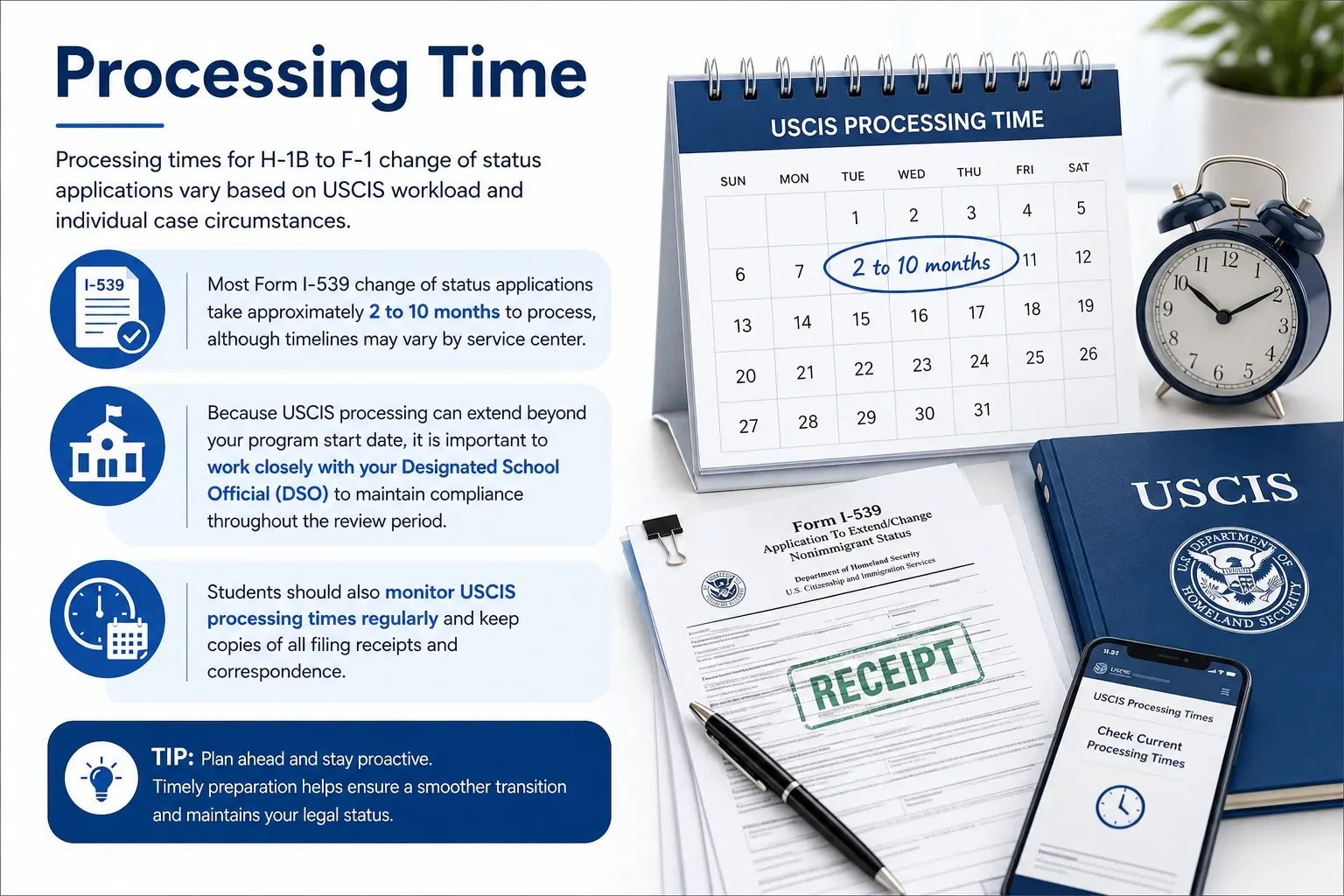
- Begin planning as early as possible after learning that your H-1B employment may end.
- Maintain valid H-1B status when filing your application.
- Carefully review all documents before submission to avoid delays or Requests for Evidence (RFEs).
- Consider consulting an immigration attorney if you have dependents, prior status issues, or an approved I-140 petition.
- Do not wait until the end of your grace period to begin the process.
Cost
The total cost of changing from H-1B to F-1 status can vary depending on your school, application complexity, and whether you choose to work with an immigration attorney. Before starting the process, it is important to budget for both government filing fees and school-related expenses.
- I-539 Filing Fee: $470 (online); $520 (paper).
- SEVIS Fee: $350.
- University Application Fee: $50-200.
- Attorney Fee: $200-500/hour; usually 3-8 hours depending on the case; $1,500–$5,000+ for a complete H-1B to F-1 change of status case.
Frequently Asked Questions
Yes, but work authorization for F-1 students is limited and must be properly authorized.
F-1 students may be eligible for:
- On-campus employment (up to 20 hours per week during academic terms)
- Curricular Practical Training (CPT)
- Optional Practical Training (OPT)
- STEM OPT Extension (for eligible STEM graduates)
Most universities require students to complete one academic year before becoming eligible for CPT. However, certain Day 1 CPT programs may allow eligible students to participate in practical training from the beginning of their academic program if the curriculum requires it.
Students should always obtain authorization before beginning any employment.
No. Most applicants can file a change of status application with USCIS while remaining in the United States.
However, some individuals may choose consular processing by departing the U.S. and applying for an F-1 visa at a U.S. embassy or consulate abroad. This option may be considered when:
- Change of status processing times are lengthy
- Travel is already planned
- USCIS processing delays create timing concerns
Before traveling internationally, applicants should carefully review their situation because travel during a pending change of status application may affect the case.
While hiring an attorney is not required, it is often recommended, especially for applicants with complex immigration histories.
Professional legal guidance may be helpful if you:
- Have an approved I-140 petition
- Recently experienced an H-1B layoff
- Have dependents changing status
- Previously used Day 1 CPT
- Have prior immigration violations or status concerns
An immigration attorney can help review documentation, identify potential issues, and strengthen your application.
If you file Form I-539 while maintaining valid H-1B status, you may generally remain in the United States while USCIS reviews your application.
However, maintaining lawful status during the transition is critical. If your application is denied or if there are status gaps, you may need to depart the U.S. and pursue F-1 visa processing abroad.
Because each situation is unique, applicants should work closely with their Designated School Official (DSO) and immigration attorney when planning timelines.
In most cases, yes.
However, students who accumulate 12 months or more of full-time CPT at the same degree level generally become ineligible for OPT at that degree level.
Part-time CPT does not affect OPT eligibility.
It is also important to understand that previous OPT usage may affect future OPT eligibility if it was used at the same degree level. Students pursuing a higher degree level may become eligible for a new period of OPT.
In most cases, a properly approved H-1B to F-1 change of status does not negatively affect future employment-based immigration applications.
However, USCIS may review whether:
- You maintained lawful status
- You complied with F-1 regulations
- Your academic program was legitimate
- Any CPT or Day 1 CPT employment was properly authorized
If you later pursue a green card, maintaining strong documentation throughout your F-1 program can help support future immigration benefits.
When preparing your explanation letter, focus on:
- Educational goals
- Career development
- Academic objectives
Rather than immigration benefits or permanent residency plans.
7 Steps from F-1 to Green Card
6 Ways for F-1 Students to Obtain a Green Card and Become Residents
Up to $20,000 per year
Merit-based scholarships are exclusively available to students who apply through Day1CPT. Awards are applied directly to tuition and do not need to be repaid.
All scholarships are exclusive to Day1CPT applicants and cannot be obtained through direct university application.
| 🌟Merit Scholarship - Most Popular Awarded based on academic background and professional experience. |
Up to $8,000/yr |
| 🌟STEM Excellence Grant For students enrolling in CS, AI, Data Science, or Engineering programs. |
Up to $5,000/yr |
| 🌟Leadership Scholarship For students with demonstrated leadership experience in their field. |
Up to $4,000/yr |
| 🌟Early Application Award Apply at least 60 days before your target semester start date. |
Up to $3,000/yr |
$2,000+ in partner savings
Exclusive discounts on tools, software, housing, and services that international students need most — negotiated directly with our partners.
Discounts are activated upon enrollment confirmation and remain valid throughout your program.
| 🌟Software & Productivity Microsoft 365, Adobe Creative Cloud, Notion, Grammarly, and more. |
Up to 60% off |
| 🌟Professional Tools LinkedIn Premium, Coursera, Udemy, and professional certification prep. |
Up to 40% off |
| 🌟Health & Wellness Health insurance plans, gym memberships, and mental health apps. |
Up to 30% off |
| 🌟Housing & Relocation Partner housing platforms and relocation service discounts. |
Up to $500 off |
[FREE] Dedicated advisor from day one
Every Day1CPT applicant is assigned a dedicated advisor who guides them through every step — from document preparation to I-20 receipt.
Average I-20 issuance time for Day1CPT applicants: 10–14 business days.
| 🌟Document Review Expert review of your SOP, recommendation letters, and transcripts before submission. |
| 🌟I-20 Expedite Support We coordinate directly with university DSOs to expedite your I-20 issuance. |
| 🌟Visa Interview Prep 1-on-1 mock interview sessions with our experienced advisors. |
| 🌟Enrollment Guidance Step-by-step guidance on course registration, orientation, and first-semester setup. |
[INCLUDED] Practical experience from semester 1
All Day1CPT partner programs include CPT as a required or elective curricular component, meaning you can begin practical experience from your very first semester.
CPT authorization is subject to individual DSO approval and USCIS regulations. Students must maintain a valid F-1 status.
| 🌟Curriculum-Embedded CPT CPT is part of your degree requirements, not an add-on. This is the key to Day 1 authorization. |
| 🌟CPT Authorization Guidance Step-by-step guidance on the CPT authorization process at your specific university. |
| 🌟Compliance Resources Access to our F-1 compliance resource library, updated regularly with USCIS guidance. |
| 🌟DSO Support Network Access to a network of experienced DSOs at all 20+ partner universities. |
[FREE] 500+ active alumni connections
Join a thriving community of Day1CPT alumni across 20+ universities. Get mentorship, referrals, and career connections from students who've been through the same journey.
Our alumni network spans 15+ countries and 200+ companies.
| 🌟Alumni Mentorship Get matched with alumni in your field for 1-on-1 mentorship sessions. |
| 🌟Annual Summit Invitation to the annual Day1CPT Student Summit — networking, workshops, and speakers. |
| 🌟Career Referral Network Access to alumni referral opportunities at top companies. |
| 🌟Private Community Access Join our exclusive Discord and WeChat communities for peer support and networking. |
🪙GoElite Rewards Program
How it works: Earn points by completing milestones during your enrollment journey.
Points are credited to your GoElite account and can be redeemed at any time via the GoElite platform.
- 🎓Get Enrolled - Earn points once you enroll to our partner univ. (+50 pts)
- 👥Refer Friends - Earn 200 points for every successful referral. (+200 pts)
- 💬Join Group Chat - Join the school WhatsApp/WeChat group. (+10 pts)
- 📝Evaluate Courses - Share course and professor experience. (+10 pts)
- 📱Share on Social - Share your experience and tag us. (+10 pts)
- ☕Starbucks Gift Card - Exchange at 1:1 ratio. ($10, $25, $50)
- 📦Amazon Gift Card - Exchange at 1:1 ratio. ($25, $50, $100, $200)
- 💳Visa Prepaid Card - Exchange at 1:1 ratio. ($200)
All Benefits Unlock When You Apply Through Day1CPT
These benefits are exclusively negotiated for our applicants. They are not available through direct university application.
Student Discounts
$2,000+ in partner savings
Exclusive discounts on tools, software, housing, and services that international students need most — negotiated directly with our partners.
Up to $3,000/yr
Application Award
Apply at least 60 days before your target semester start date.
Application Award
Up to $8,000/yr
Merit Scholarship
Awarded based on academic background and professional experience.
Merit Scholarship
Up to $5,000/yr
STEM Excellence
For students enrolling in CS, AI, Data Science, or Engineering programs.
STEM Excellence
Up to $4,000/yr
Leadership Grant
For students with demonstrated leadership experience in their field.
Leadership Grant
Book a Free Consultation!
We will guide you with the step-by-step application to your U.S. dream
For many international students, a successful H-1B-to-F-1 change of status can create new opportunities through CPT, OPT, STEM OPT, and future employment-based immigration pathways.
GoElite Rewards Program
Earn points for every milestone — redeem for real cash rewards. 1 Point = $1 USD