.png?width=600&height=150&name=D1CC%20Logo%20Version%202%20(1).png "Day 1 CPT logo")
Quick Insights
- The DHS Final Rule does not eliminate or prohibit Day 1 CPT.
- DHS specifically declined to make changes to Curricular Practical Training (CPT), including Day 1 CPT, because it was outside the scope of this rulemaking.
- The rule replaces Duration of Status (D/S) with a fixed period of admission for most F-1 students admitted after the rule takes effect.
- Students may need to plan earlier for an Extension of Stay (Form I-539) if they cannot complete their academic program within their authorized admission period.
- Current Day 1 CPT students should review their program timeline with their Designated School Official (DSO) before the new rule becomes effective.
The publication of the DHS Final Rule ending Duration of Status (D/S) has created uncertainty for many international students—especially those currently enrolled in or considering a Day 1 CPT program.
One of the most common questions students are asking is:
"Will the new rule eliminate Day 1 CPT?"
The short answer is no.
The new regulation does not ban Day 1 CPT or change the existing Curricular Practical Training (CPT) regulations. However, it does introduce broader changes to how F-1 students are admitted to the United States, how long they may remain in the country, and when an Extension of Stay (EOS) may be required. Those changes can affect how Day 1 CPT students plan their education and immigration timeline.
If you're currently enrolled in a Day 1 CPT program—or thinking about transferring to one—understanding what has changed and what has stayed the same is essential.
This guide explains whether the 2026 DHS Final Rule changes Day 1 CPT, what the new Duration of Status framework means for current and future F-1 students, how the rule may affect academic planning, and what steps you should take now to maintain status and prepare before the new requirements take effect.
Table of Contents
- What Changed Under the DHS Final Rule?
- Does the New Rule Affect Day 1 CPT?
- Why Day 1 CPT Students Should Still Pay Attention
- Current Students vs. Future Students: Is There a Difference?
- Common Misconceptions About the New Day 1 CPT Rule
- What If You're Planning to Transfer to a Day 1 CPT University?
- Five Steps Every Day 1 CPT Student Should Take Now
- Frequently Asked Questions
- Conclusion
What Changed Under the DHS Final Rule?
On July 17, 2026, the Department of Homeland Security (DHS) published its Final Rule replacing Duration of Status (D/S) with a fixed period of admission for F-1 students, J exchange visitors, and I foreign media representatives.
Under the Final Rule:
- Most F-1 students will receive a fixed admission period, generally tied to the length of their academic program and not exceeding four years.
- Students who need additional time may need to file Form I-539, Application to Extend/Change Nonimmigrant Status, with USCIS before their authorized stay expires.
- The F-1 grace period after program completion is reduced from 60 days to 30 days.
- Certain school transfer and educational objective restrictions become stricter for future students under the new framework.
These changes primarily affect how long students may remain in the United States, rather than how CPT itself operates.
Official Sources:
Trump Administration Issues Final Rule to End Foreign Student Visa Abuse
Does the New Rule Affect Day 1 CPT?
The answer is not directly.
One of the most important points in the DHS Final Rule is that the government specifically declined to change Curricular Practical Training (CPT), including Day 1 CPT.
According to the Final Rule summary:
"Changes to CPT (including Day-1 CPT) — deemed outside the scope of this rulemaking."
In other words, the regulations governing Day 1 CPT remain the same.
Students enrolled in eligible SEVP-certified universities may continue participating in Day 1 CPT when:
- Practical training is an integral part of the curriculum.
- CPT is authorized by the university's Designated School Official (DSO) before employment begins.
- The student maintains valid F-1 status and complies with all university and immigration requirements.
The Final Rule changes the immigration framework surrounding F-1 status, but it does not rewrite the eligibility requirements for CPT itself.
2026 D/S Final Rule: What International F-1 Students Need to Know
Why Day 1 CPT Students Should Still Pay Attention
Although Day 1 CPT itself remains unchanged, the new rule introduces changes that may influence how students plan their education.
Instead of focusing only on maintaining enrollment and CPT authorization, students should now also pay close attention to:
- The expiration date of their authorized admission period.
- Whether their academic program is likely to finish within that period.
- Whether an Extension of Stay may be needed if additional time becomes necessary.
- Future school transfers and degree progression under the new regulations.
For many students, the biggest change is not how Day 1 CPT works, but how early they need to begin planning.
Waiting until the end of a program to think about immigration options may no longer provide enough time under the new fixed-admission system.
Is Day 1 CPT Legal? Understand Day 1 CPT from the Legal Perspective
Day 1 CPT Requirements: How to Qualify and Apply Successfully
Current Students vs. Future Students: Is There a Difference?
The Final Rule includes transition provisions that distinguish between students already studying in the United States and those entering after the rule becomes effective.
Current Day 1 CPT Students
If you are already studying in the United States under the existing Duration of Status (D/S) framework, transition provisions may allow you to continue under your current admission until the applicable transition rules apply.
However, international travel and future admissions could subject you to the new fixed-period system.
Future Day 1 CPT Students
Students beginning a new F-1 program after the rule takes effect should expect to receive a fixed admission period rather than a D/S notation on their Form I-94.
This makes choosing the right academic program—and understanding its expected completion timeline—more important than ever.
Common Misconceptions About the New Day 1 CPT Rule
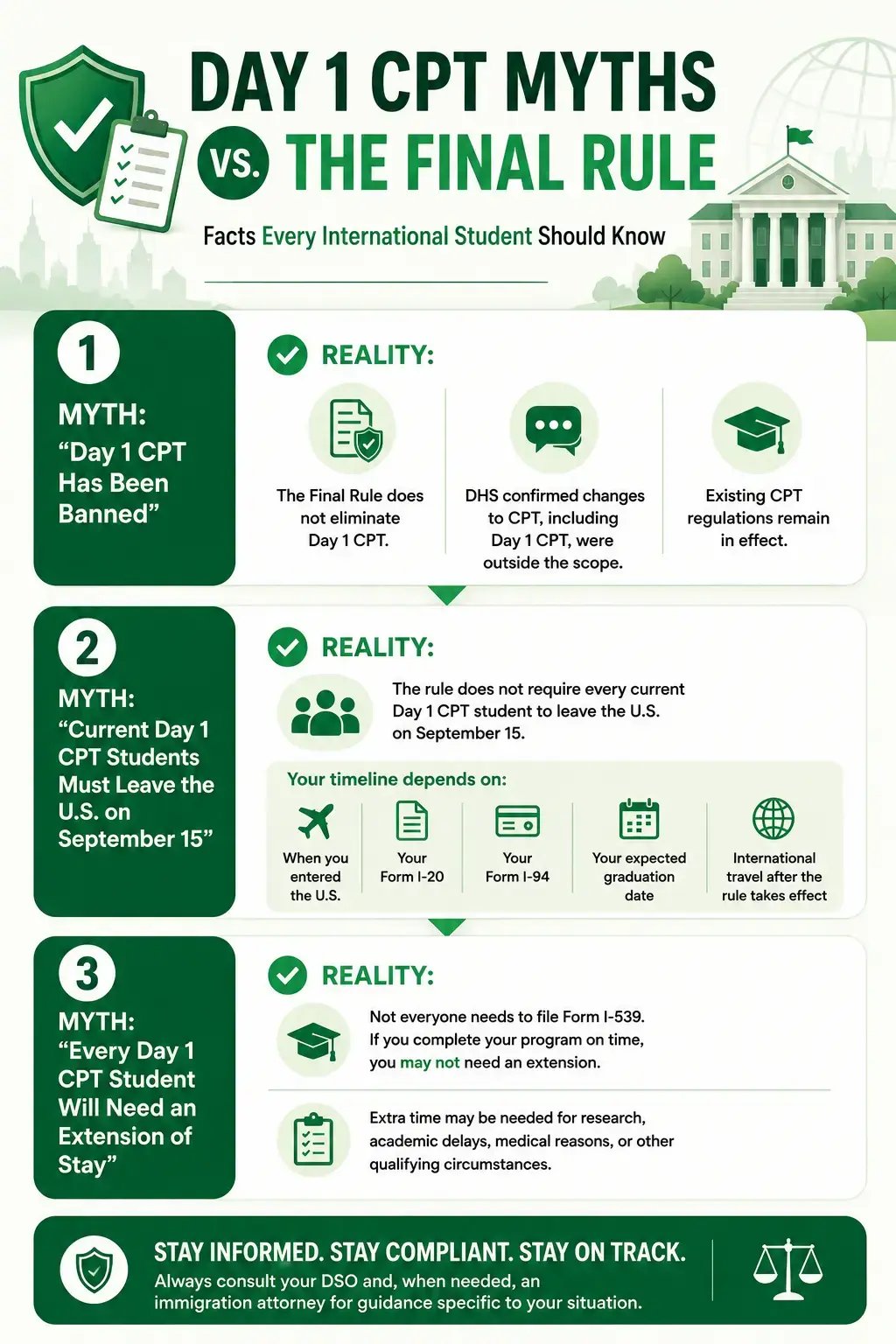
Since DHS published the Final Rule, many international students have encountered misleading information online claiming that Day 1 CPT is ending or that students currently enrolled in Day 1 CPT programs will automatically lose their status.
These claims are not supported by the Final Rule.
Below are some of the most common misconceptions—and what the rule actually says.
What If You're Planning to Transfer to a Day 1 CPT University?
Many students currently on OPT, STEM OPT, or another F-1 program are considering transferring to a Day 1 CPT university.
The Final Rule does not prohibit transferring to another SEVP-certified school, but it introduces new restrictions that may affect some future transfers, particularly during the first academic year and for certain educational objective changes. It also allows limited SEVP exceptions for extenuating circumstances.
If you're planning to transfer, consider the following:
- Confirm that the university is SEVP-certified.
- Review the school's CPT policies and residency requirements.
- Coordinate your SEVIS transfer carefully with both schools.
- Ensure your transfer supports your long-term academic and career goals.
- Discuss your timeline with your DSO before making any decisions.
A well-planned transfer is generally easier than trying to resolve immigration issues after deadlines have passed.
Should You Transfer Before September 15?
This is one of the most common questions students are asking since the Final Rule was published.
The answer depends on your individual circumstances.
You may benefit from speaking with your DSO or an immigration professional if you are:
- Near the end of your OPT or STEM OPT period.
- Planning to begin a Day 1 CPT program.
- Considering transferring schools.
- Unsure whether your current academic timeline extends beyond your authorized stay.
- Unsure how the transition provisions apply to your case.
Rather than waiting until the rule takes effect, now is the time to understand your options and prepare the documentation you may need.
Complete Guide to Day 1 CPT
Complete List of Day 1 CPT Universities
Five Steps Every Day 1 CPT Student Should Take Now
Whether you're already enrolled in a Day 1 CPT program or planning to transfer, these proactive steps can help you prepare for the new immigration framework.
1. Review Your Academic Timeline
Compare your expected graduation date with your Form I-20 and anticipated authorized admission period.
If you believe your program may extend beyond your authorized stay, begin discussing your options early.
2. Check Your Immigration Documents
Keep copies of your passport, Form I-20, Form I-94, CPT authorization, employment documents, and make sure information is accurate and up to date.
3. Speak With Your Designated School Official (DSO)
Your DSO can help explain how the Final Rule may affect your individual situation, including transfers, SEVIS records, and expected program completion.
4. Avoid Relying on Social Media Rumors
Immigration policy changes often lead to misinformation online.
Whenever possible, rely on official guidance from DHS, USCIS, Study in the States, or your university rather than unverified posts or discussion forums.
5. Start Planning Early
The biggest lesson from the Final Rule is simple. Students who plan early generally have more options than those who wait until their authorized stay is close to expiring.
Understanding your academic timeline today can help you avoid unnecessary immigration complications tomorrow.
Frequently Asked Questions
Will the new DHS Final Rule eliminate Day 1 CPT?
No. The Final Rule does not eliminate or prohibit Day 1 CPT. DHS specifically stated that changes to Curricular Practical Training (CPT), including Day 1 CPT, were outside the scope of this rulemaking, meaning the existing CPT regulations remain unchanged.
Can I still transfer to a Day 1 CPT university after the new rule takes effect?
Yes, but the new rule introduces additional restrictions on certain school transfers and educational objective changes, particularly during the first academic year and for graduate-level students.
Depending on your circumstances, transfer options may be more limited than before; make early planning with your DSO.
Do all Day 1 CPT students need to file an Extension of Stay (Form I-539)?
No.
Whether you need to file an Extension of Stay (EOS) depends on your individual situation, including your authorized admission period, expected graduation date, and whether you can complete your program before your authorized stay expires.
Students who finish on time may never need to file an Extension of Stay.
Will my CPT work authorization change?
No.
The Final Rule changes how F-1 students are admitted and how long they may remain in the United States, but it does not change the eligibility requirements for CPT authorization.
Students must still:
- Attend an SEVP-certified university
- Maintain valid F-1 status
- Receive CPT authorization from their DSO before beginning employment
- Continue meeting all university and immigration requirements
What happens if my program takes longer than expected?
If your academic program extends beyond your authorized admission period, you may need to explore options such as an Extension of Stay (Form I-539) or another lawful immigration pathway, depending on your circumstances.
Rather than waiting until your authorized stay is about to expire, discuss your timeline with your DSO as early as possible.
Should I transfer before September 15?
There isn't a single answer for every student.
Your best course of action depends on factors such as:
- Your current immigration status
- Your expected graduation date
- Your SEVIS record
- Your current university
- Your long-term academic goals
If you're considering transferring to a Day 1 CPT university, speaking with your DSO before making a decision can help you understand how the Final Rule applies to your specific situation.
Conclusion
The new DHS Final Rule has understandably created uncertainty for international students, but one important fact remains clear:
Day 1 CPT has not been eliminated.
DHS specifically chose not to change Curricular Practical Training regulations, meaning eligible students may continue participating in Day 1 CPT under the existing rules.
What has changed is the broader immigration framework surrounding F-1 status. Instead of relying on the traditional Duration of Status (D/S) system, many students admitted after the rule takes effect will receive a fixed period of admission, making early planning more important than ever.
Whether you're currently enrolled in a Day 1 CPT program or considering transferring to one, your focus should be on:
- Understanding how the Final Rule applies to your individual situation.
- Planning your academic timeline well before your authorized stay expires.
- Working closely with your DSO to maintain lawful F-1 status.
- Staying informed through official DHS and USCIS guidance instead of relying on rumors or social media speculation.
By preparing early, you can make more informed decisions about your education, employment, and long-term immigration plans.
Continue Planning Your Next Steps
The new Duration of Status Final Rule is changing how international students plan their education and immigration journey. While Day 1 CPT remains available, understanding your options before your authorized stay expires is important.
Visit ExtensionofStay.com to access free educational resources, register for upcoming webinars, and explore exclusive legal guidance designed to help international students prepare for the new DHS Final Rule.

Share this

Full-Time vs Part-Time CPT: What's Best for International Students?

Is Your OPT Ending in 30 Days? Here's What You Can Do Before it Ends